Refurbishment of the stairs started promptly as planned on Tuesday morning shortly after 8am.
I say "refurbishment" rather than "replacement" deliberately, as we're not having the entire staircase replaced. This particular company don't do that in any case, but it would have been (a) far too expensive - more than double what we eventually paid - and (b) unnecessary, as the main carcase is still sound. The bits we don't like are the more visible and slightly less structural items, like newel posts, rails and spindles. As it happens, these guys also work on the external and internal stringers, but only to encase them in new wood, rather than replace them entirely.
The project stretched beyond the original estimates of either the designer (a full day, maybe two) or the surveyor (definitely two days, possibly a few hours on a third day), which was strange because when it was booked in, they said they had two other jobs to do the same week. During a break in proceedings on the first day - with all the hand rails sawn off and only two of the original newel posts still in place - one of the joiners admitted that they "never do these in less than three days" and in the end, for one reason or another, one of them had to come back for an hour or so this morning for some finishing touches.
Still, the end result is definitely worth it. You'll have to wait for pics until a carpet has been chosen and fitted. The original stairs were painted red and white, and since they're the only bit that remains unchanged they don't really set off the lovely warm oak to its best advantage!
Friday, March 18, 2011


Sunday, March 13, 2011
New newels a-coming
Our mental schedule had the new stairs being fitted after May Bank Holiday, so it was a surprise to receive a phone call last week to say all the "product" was ready and they had a fitting appointment free next week.
Fortunately I'd been pressing on with the decorating so that we would stand a chance of being ready whenever they were, and the intervening weekend gave ample time to complete the last phase of the painting - the top coat on the woodwork (at least around the stairs area) - before the joiners arrive on Tuesday.
I set to yesterday morning with a brand new tin of Dulux Satinwood - my "gloss" of choice for many years owing to its classy satin finish, but by teatime I was beginning to worry that it was taking an awfully long time to dry. A tentative touch in an out-of-the-way corner gave a surprising result: it was dry already. Dry and glossy. Not what we wanted at all.
At first I thought Dulux had suffered a manufacturing wobbler and packaged regular gloss in a Satinwood tin, but as usual Google is your friend, and a quick search threw up several references to DIY and professional decorator forums where everyone was bemoaning the new paint mix - light on volatile organics as per new EU regulations, and consequently taking much longer to dry out properly than it used to.
"Don't worry," wrote one professional long-time user of Satinwood, "you'll see the difference after 24 hours, but it can take a couple of weeks before the satin effect is completely there."
Sure enough this morning the high gloss sheen is already toned down a couple of notches. Phew.
Fortunately I'd been pressing on with the decorating so that we would stand a chance of being ready whenever they were, and the intervening weekend gave ample time to complete the last phase of the painting - the top coat on the woodwork (at least around the stairs area) - before the joiners arrive on Tuesday.
I set to yesterday morning with a brand new tin of Dulux Satinwood - my "gloss" of choice for many years owing to its classy satin finish, but by teatime I was beginning to worry that it was taking an awfully long time to dry. A tentative touch in an out-of-the-way corner gave a surprising result: it was dry already. Dry and glossy. Not what we wanted at all.
At first I thought Dulux had suffered a manufacturing wobbler and packaged regular gloss in a Satinwood tin, but as usual Google is your friend, and a quick search threw up several references to DIY and professional decorator forums where everyone was bemoaning the new paint mix - light on volatile organics as per new EU regulations, and consequently taking much longer to dry out properly than it used to.
"Don't worry," wrote one professional long-time user of Satinwood, "you'll see the difference after 24 hours, but it can take a couple of weeks before the satin effect is completely there."
Sure enough this morning the high gloss sheen is already toned down a couple of notches. Phew.
Friday, March 11, 2011
Greek Night
As regular readers will know, we have a tradition of "safari nights" on our street where we journey from house to house for each course of an n-course meal (depending on the number of houses involved in that particular safari). Each one has a different theme, tonight's being Greek.
As you'll have seen earlier this week, tonight's safari was only organised last Friday, so we've not had long to arrange a costume. I was thwarted at every turn, as I wanted to do something a bit more original than a draped sheet (no offence to draped sheets, or those who wear them!) but every costume I found was either out of stock or not available in my size.
 Until I found this. Which gave me the idea I was looking for, and was do-able in the time remaining. Especially since we still had a large cardboard box lying around from the last flat-pack furniture delivery which was the perfect size for the top and bottom plinth.
Cannibalising an old fitted sheet sufficed for the both the column (with Nat's help to spray-on some suitably Doric fluting) and the drapery around the "bust", white body paint turned my exposed body parts to stone and the whole thing was topped off with a "gold leaf" laurel from an online costumier.
Here's the final result.
 With a little more time and thought I could probably have made a better job but even so I was quite pleased with it, and the surprise (or even shock in some cases) of the arriving guests was well worth the effort. I chose to stand over in a corner, unmoving, until each group of guests realised it was me.
Walking was somewhat hampered, and sitting impossible, so once everyone had enjoyed the full effect (i.e. shortly after we arrived at the second house) I removed the bottom half of the costume, but remained in "bust mode" for much of the rest of the evening, even though it made negotiating doorways... interesting. Chalk up (haha!) another successful safari night, with buckets of stifado, moussaka and ouzo thrown in. Brilliant.
As you'll have seen earlier this week, tonight's safari was only organised last Friday, so we've not had long to arrange a costume. I was thwarted at every turn, as I wanted to do something a bit more original than a draped sheet (no offence to draped sheets, or those who wear them!) but every costume I found was either out of stock or not available in my size.
Cannibalising an old fitted sheet sufficed for the both the column (with Nat's help to spray-on some suitably Doric fluting) and the drapery around the "bust", white body paint turned my exposed body parts to stone and the whole thing was topped off with a "gold leaf" laurel from an online costumier.
Here's the final result.

Walking was somewhat hampered, and sitting impossible, so once everyone had enjoyed the full effect (i.e. shortly after we arrived at the second house) I removed the bottom half of the costume, but remained in "bust mode" for much of the rest of the evening, even though it made negotiating doorways... interesting. Chalk up (haha!) another successful safari night, with buckets of stifado, moussaka and ouzo thrown in. Brilliant.
Tuesday, March 08, 2011
Statue of liberty
The liberty being our neighbours - Torsten & Keith - who are shortly to depart these shores for a new life in Portugal. The statue being my chosen costume for the forthcoming Greek-themed safari night in honour of their leaving, for which we had less than a week's notice. It's happening on Friday, and I'm trying to pull together a statue costume in time.
Thank God for Internet shopping, rapid order fulfilment, and first class post. My body paint arrived today (successfully tested for wear, smudging, washability and skin reaction) and I'm hopeful that the laurel wreath will arrive tomorrow. The rest is all bodged together from old cardboard boxes, sprayed with B&Q project paint, and an old fitted sheet that was surplus to requirements.
First stage assembly of the top and bottom plinths of a mock-Doric column was completed today. Now I just have to figure out the best way of spray-painting the fluting on the column and I'm all set.
Thank God for Internet shopping, rapid order fulfilment, and first class post. My body paint arrived today (successfully tested for wear, smudging, washability and skin reaction) and I'm hopeful that the laurel wreath will arrive tomorrow. The rest is all bodged together from old cardboard boxes, sprayed with B&Q project paint, and an old fitted sheet that was surplus to requirements.
First stage assembly of the top and bottom plinths of a mock-Doric column was completed today. Now I just have to figure out the best way of spray-painting the fluting on the column and I'm all set.
Saturday, March 05, 2011
The last coat...
...is in sight.
For today, a bonus: I finished before 2.30pm. Second coat of undercoat on the front door (that's the last of the undercoating) and cutting in the second emulsion coat on walls and ceiling, leaving only the rolling to do. That'll be a quick job, so I'm on track for an early finish tomorrow too :o)
 Another thing that came to mind as I carefully cut in around the dado rails and skirting: this job marks the final demise of the rag-rolled flame-effect colours that used to dominate the whole house; a legacy of the previous owners. Flame yellow in the dining room, orange and red in the living room, blood-red in the bathroom. One by one they've been built over, plastered over, painted over, or all three. The last bastion of rag rolling was the sub-dado area in the hall and stairs. Orange and yellow, it was. Now it's only visible as a slight mottling of the first coat of white emulsion in the photo here. The second coat, coming tomorrow, will be enough to see it off for good.
I researched the Feng Shui-ness of these colours. Knowing a little about those previous owners I'm pretty certain the colours were chosen for a reason - along with the copper, gold and bronze paint they used on all the picture rails. Sure enough, they're all "Yang" colours. All associated with vitality, ambition, joy and optimism. Interesting to note during my research that white - now the predominant colour of the hall - is the "colour of ultimate purity." It is, allegedly, "an all around colour of protection, bringing peace and comfort, alleviating emotional shock and despair, helping cleanse emotions, thoughts and spirit."
I think that's a pretty good choice for the first room you enter after an exhausting day at the coalface of life. All we need now is to add in a little gold. Because it is "related to abundance and power, higher ideals, wisdom, understanding" and is "mentally revitalising, energising and inspiring." Just what we need.
For today, a bonus: I finished before 2.30pm. Second coat of undercoat on the front door (that's the last of the undercoating) and cutting in the second emulsion coat on walls and ceiling, leaving only the rolling to do. That'll be a quick job, so I'm on track for an early finish tomorrow too :o)

I researched the Feng Shui-ness of these colours. Knowing a little about those previous owners I'm pretty certain the colours were chosen for a reason - along with the copper, gold and bronze paint they used on all the picture rails. Sure enough, they're all "Yang" colours. All associated with vitality, ambition, joy and optimism. Interesting to note during my research that white - now the predominant colour of the hall - is the "colour of ultimate purity." It is, allegedly, "an all around colour of protection, bringing peace and comfort, alleviating emotional shock and despair, helping cleanse emotions, thoughts and spirit."
I think that's a pretty good choice for the first room you enter after an exhausting day at the coalface of life. All we need now is to add in a little gold. Because it is "related to abundance and power, higher ideals, wisdom, understanding" and is "mentally revitalising, energising and inspiring." Just what we need.
Sunday, February 27, 2011
Stunning Lines

Never mind, I'll find someone like you.
Adele has been all over the UK and world media for the last four years or so, but nothing quite prepares you for the quality of the songs - all the songs - on her second album: 21. For me though (and apparently, since 21 has only been out a little over a month and sales are already in the hundreds of thousands, for many others too), even among the many gems on this album that single line from the chorus of Someone Like You is one of the most breathtakingly, heart-achingly powerful I've ever heard.
So few words to crystallise the loss of hope, the final realisation that love has gone, but even while it's leaving you don't wish any hurt for the other even though you're hurting. You loved them that much. Never mind. Don't worry about me. All I need to do is find another you. Simple.
The power of the words is, of course, multiplied by Adele's amazing performance. If you haven't seen it I suggest you get yourself over to YouTube sharpish. You'll be glad you did. But it is the words that do it for me every time. The album insert credits Adele Adkins and Dan Wilson as co-writers. Top job guys. It really is a line I wish I'd written.
Thursday, February 24, 2011
Vinyl: Airborne

Owned on digital media: No
Want to replace: No
During that eventful year when I was the student union Socials Secretary, one of the bands I most enjoyed putting on was Curved Air, mainly because it gave me chance to get close to lead singer Sonja Kristina; every inch the young man's dream.
I can't honestly claim to have been a huge Curved Air fan - this was the only album of theirs in my collection - and with the passing years the memory of how it sounded, or even what tracks it held, has faded to almost nothing. So I was grateful to Wikipedia (and the *real* fans who maintain copious detail of the music) for some insight into what was on this particular album, and also for the unexpected memory jog that the title "Hot & Bothered" gave me, bringing back as it did the recollection of sitting in my garret room in halls, spinning the vinyl and singing along while pretending to write out my lecture notes for the day.
That Wikipedia page held a few more surprises. You can tell I've never been much of a "fan boy" when it comes to music. Never really followed many bands to any great extent (apart from the obvious Caravan and Genesis), or got to know the names of the band members much beyond the lead singer. So I never realised Stewart Copeland was their drummer before he went on to The Police, or that he later married Sonja Kristina. Following her Wikipedia link (purely in the interests of research, naturally) uncovered the revelation that at the age of 61 she is still touring, still making music, releasing a (compilation) album as recently as last year. Good onja, Sonja!
Tuesday, February 22, 2011
Book Review: If On A Winter's Night A Traveler

So it's perhaps unfortunate that my first exposure to him came through possibly his most inaccessible work. A book about a reader trying to read a book, where the odd-numbered chapters are written in the second person and attempt to tell you what you, the reader, are doing and thinking, and the even-numbered chapters are chapters from the book "you" are trying to read. So, the first question that might come to mind is "Why?" closely followed by "What?"
If you're sufficiently interested you can do some research on the concept of metafiction. This book is widely reviewed as being "fresh, original, clever, inventive, masterful," etc, etc. But there are almost as many negative reviews where you'll find words such as "boring, too clever, tedious, impenetrable."
So, the ultimate Marmite book, then? Possibly. I guess it very much depends on whether you're looking for something different and potentially intriguing, and prepared to wade through chapter after chapter of nothing much happening to get it. And, if and when you finally do "get it", was it all worth it? I firmly believe there's a reason so few books are written in the second person. It doesn't work. Or at least, it doesn't work for a fair percentage of readers (me included), and why would an author contemplate using such a device when it's guaranteed to limit his or her audience? Personally, I don't like being told that "I" am doing this or that, or thinking this or that, when clearly I am not. Suspension of disbelief doesn't even come into it, as there is no belief created in the first place.
Apparently those sequential first chapters, while initially appearing to be random and unconnected, are in fact connected in some nebulous way and contribute somehow to the eventual resolution (inasmuch as this novel can be said to have a resolution - when it comprehensively fails to end in another explosion of "cleverness") but you'd have to really want to hunt for these clues and quite frankly I was so bored with the whole thing I gave up halfway through, as have a number of reviewers before me. A handful of bookclub readers said they had given up in the past but found it easier to read at the second attempt. Maybe knowing in advance how the book "works" gives you some protection from the tedium.
But for me, I'm happy to agree with an Amazon reviewer who asked why, when there are so many other books out there to read and so little time in which to read them, would you bother wasting any of that precious time on this?
I have always had a problem with books that are too clever for their own good - Cloud Atlas being the most often mentioned example. But this takes cleverness (and hence problem) to a whole other level. It is overtly cynical and manipulative of the reader. Yes, fiction in general does this. Obviously. Stories are intended to move you, transport you to other worlds, other lives, other experiences. Have we learned anything new by having that fact rammed down our throats by Calvino? Is it really "playful" as some reviewers put it? Or is it exploitative? I don't care. I just don't want to know.
Sunday, February 20, 2011
Sand(ing) in my eyes
It's done!
In the end, power tools were the answer. Or, a power tool, to be precise. A detail sander:
 A recent purchase intended to speed up the task of smoothing off large areas of unfinished purlin (at which it excelled), I was always going to use it on the front door panels. They stretch the entire width of the hall and would have taken an age to do by hand. Once I got started with this little wonder and a pack of 25 sanding sheets, I thought I may as well carry on. It made short work of the dado, skirting, and door frames, allowing me to finish in a single afternoon an area almost double that which has already taken two weekends to do manually.
Power tools. Always the answer. Yes, I did wear a mask.
In the end, power tools were the answer. Or, a power tool, to be precise. A detail sander:

Power tools. Always the answer. Yes, I did wear a mask.
Thursday, February 17, 2011
More acreage to paint
And just like that, the plastering is all done. It only happens "just like that" from my perspective. The other perspective - that of a plasterer balancing on a plank that is resting between a rung of a ladder and another plank, with the second plank itself stretched between a second ladder and a set of steps, holding a hawk loaded with plaster in one hand and applying it with a trowel held in the other - doesn't bear thinking about!
Two men yesterday, and three men today. Five man days. It's a big job.
For my part, after two weekends of sanding the landing is ready to paint. Four doorways, skirting and dado rail. Only I won't start painting until the rest of the sanding is done. Prep first, paint last. So still to come, there's the dado down the stairs. Apron. Window on the stairs. Front door (all wood panels, the width of three doors), five more doorways. More dado and some picture rail thrown in for good measure. Oh, and the cornice in the hall. Then I can paint all that, together with two ceilings, stair well, and all the walls that'll need two coats of high density white emulsion, and then a couple more coats of the mid-gray tone we've chosen for the sub-dado area.
And this, don't forget, is not the aforementioned Large Decorating Project. Oh no. This is just the Piddling Little Decorating Project That Will Do To Be Going On With.
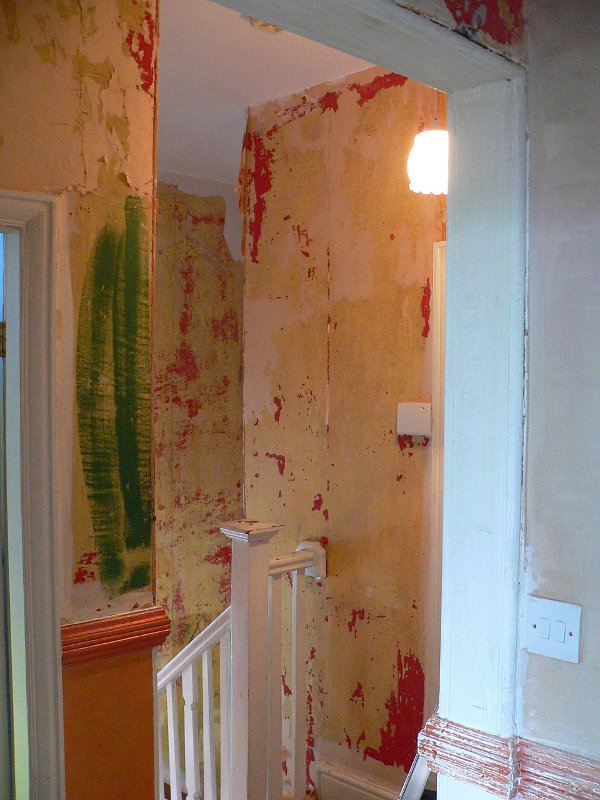
Here's some "before and after" pics to keep you occupied while I finish sanding. The "before" ones are post-wallpaper-stripping. The "after" ones show the new plaster in the process of drying out.


Two men yesterday, and three men today. Five man days. It's a big job.
For my part, after two weekends of sanding the landing is ready to paint. Four doorways, skirting and dado rail. Only I won't start painting until the rest of the sanding is done. Prep first, paint last. So still to come, there's the dado down the stairs. Apron. Window on the stairs. Front door (all wood panels, the width of three doors), five more doorways. More dado and some picture rail thrown in for good measure. Oh, and the cornice in the hall. Then I can paint all that, together with two ceilings, stair well, and all the walls that'll need two coats of high density white emulsion, and then a couple more coats of the mid-gray tone we've chosen for the sub-dado area.
And this, don't forget, is not the aforementioned Large Decorating Project. Oh no. This is just the Piddling Little Decorating Project That Will Do To Be Going On With.
Here's some "before and after" pics to keep you occupied while I finish sanding. The "before" ones are post-wallpaper-stripping. The "after" ones show the new plaster in the process of drying out.


Tuesday, February 15, 2011
Time slips by
One thing that's always bugged us about this house is the stairs. They're quite narrow but there's not a lot we can do about that without an extortionately expensive and invasive replacement. Width isn't the main gripe though. Worst is the newel caps, which are large and square, and just the right height to catch your upper arm as you climb past, leaving you with a sore arm at best or occasionally a bruise. Next: the creaks. Pretty much every tread creaks, some much worse than others. And finally there's the look. Tatty, old and cheap. Painted pine. Very definitely a bargain basement kind of staircase.
So we found a refurb company and decided to go ahead.
Couple of days later, I got to thinking. It's always best, I find, to do your thinking after the major decision has been made. That way any additional work created by said major decision has to be done. Immediately. It can't be put off. My thinking went something like: "the whole hall, stairwell, and landing needs redecorating. I don't want to be splashing paint everywhere when we've had thousands of pounds worth of staircase installed." My next thought was even more buttock clenching: "If we strip this paper off and the walls need replastering, I definitely don't want that doing post-staircase."
We got started with the stripping the next day, the walls did need skimming, I called the builder and he's coming tomorrow. But all of that isn't really the point of this post. It's just the background to why, this morning, the central heating timer/thermostat was balanced on the bottom newel post.
In preparation for the plastering, I'd removed everything removable from the walls. Since it's a wireless transmitter, that included the timer. But it's also the thermostat, and we soon discovered that position was critical. I stuck it on top of the burglar alarm unit at first. The small amount of heat rising from that was enough to keep the thermostat from activating the boiler. We sat shivering in the lounge until I realised what was going on, and moved it onto the microwave. But the kitchen is by far the coldest room in the house. The boiler fired constantly but the stat never reached its target. In the lounge, we sweated.
After several more attempts, we found just the right non-wall position for it. On top of the newel post. The perfect place for me, coming downstairs in the dark and reaching for support, to send it flying.
It hit the hall floor and with that unmistakably expensive sound of shattering electronics, broke into a million pieces. Well, fourteen. Only I didn't know that when I turned the light on. I only found 11. The case, the circuit board, the display, its mount and its clear plastic window, the battery trays (2 off), three of the four batteries, and a little rubber thingy. I had no idea what that was.
I carried the bits into the kitchen where the light was better and took stock. The first thing obviously missing was the fourth battery which I found, after a very brief search, under the hall radiator. Then I panicked. I'd only ever seen this device - it's called a digistat - looking like this:
 It didn't look much like that now. But how damaged was it really? I took a closer look. The circuit board was still in one piece. No cracks, or displaced components. The display didn't appear to be broken, and its connector - a single strip protected by a rubber sleeve - was still attached. I discovered two other rubber thingies on the circuit board. The shape of a leprechaun's hat but only about four millimetres tall, they have a tiny carbon plunger inside. Sitting beneath the switches, when pressed the rubber deforms allowing the carbon plunger to touch the circuit board and make a connection between two half-moon shaped gold contacts. Clever stuff. I attached the third rubber dude and then panicked again. The unit has four switches.
I went back and searched the hall. Amazingly, since the gaps in the floorboards are easily wide enough for these guys to drop through, I found the fourth hat. It was then I noticed there was a hole in the case where the fourth switch should be. The one with the "+" symbol was missing. Until then I hadn't even realised the switches were separate pieces, as the "-", "SET?" and "SELECT" buttons had stayed with the case. Another search of the hall failed to turn up the last switch, but I caught sight of it under the coffee table by the living room door. It had bounced six feet further than any other piece.
OK. Battery trays slid into place. Rubber hats all attached. Display contact positioned above gold contact strip, and plastic insert in place to keep the display level. Window clipped over that whole assembly, switches all pushed into their holes, and... align... and... press. No click. Ah. You can't close the case when the battery trays are inserted. Remove battery trays. Replace rubber hat that's dropped off. Replace switch that's fallen out again. Align. Press. CLICK!
Breathe an initial sigh of relief. Now for the real test. Insert batteries.
The display lit up and showed 12:00. Setting the time worked. Setting the temperature worked. Switching the mode to "timed" made the boiler fire up. Success!
Later this morning our plumber arrived to service the boiler and I told him the story. "You did well to get that back together," he said. "I've never seen one out of its case - I wouldn't know where to start."
"And they cost about £120 to replace."
So we found a refurb company and decided to go ahead.
Couple of days later, I got to thinking. It's always best, I find, to do your thinking after the major decision has been made. That way any additional work created by said major decision has to be done. Immediately. It can't be put off. My thinking went something like: "the whole hall, stairwell, and landing needs redecorating. I don't want to be splashing paint everywhere when we've had thousands of pounds worth of staircase installed." My next thought was even more buttock clenching: "If we strip this paper off and the walls need replastering, I definitely don't want that doing post-staircase."
We got started with the stripping the next day, the walls did need skimming, I called the builder and he's coming tomorrow. But all of that isn't really the point of this post. It's just the background to why, this morning, the central heating timer/thermostat was balanced on the bottom newel post.
In preparation for the plastering, I'd removed everything removable from the walls. Since it's a wireless transmitter, that included the timer. But it's also the thermostat, and we soon discovered that position was critical. I stuck it on top of the burglar alarm unit at first. The small amount of heat rising from that was enough to keep the thermostat from activating the boiler. We sat shivering in the lounge until I realised what was going on, and moved it onto the microwave. But the kitchen is by far the coldest room in the house. The boiler fired constantly but the stat never reached its target. In the lounge, we sweated.
After several more attempts, we found just the right non-wall position for it. On top of the newel post. The perfect place for me, coming downstairs in the dark and reaching for support, to send it flying.
It hit the hall floor and with that unmistakably expensive sound of shattering electronics, broke into a million pieces. Well, fourteen. Only I didn't know that when I turned the light on. I only found 11. The case, the circuit board, the display, its mount and its clear plastic window, the battery trays (2 off), three of the four batteries, and a little rubber thingy. I had no idea what that was.
I carried the bits into the kitchen where the light was better and took stock. The first thing obviously missing was the fourth battery which I found, after a very brief search, under the hall radiator. Then I panicked. I'd only ever seen this device - it's called a digistat - looking like this:
I went back and searched the hall. Amazingly, since the gaps in the floorboards are easily wide enough for these guys to drop through, I found the fourth hat. It was then I noticed there was a hole in the case where the fourth switch should be. The one with the "+" symbol was missing. Until then I hadn't even realised the switches were separate pieces, as the "-", "SET?" and "SELECT" buttons had stayed with the case. Another search of the hall failed to turn up the last switch, but I caught sight of it under the coffee table by the living room door. It had bounced six feet further than any other piece.
OK. Battery trays slid into place. Rubber hats all attached. Display contact positioned above gold contact strip, and plastic insert in place to keep the display level. Window clipped over that whole assembly, switches all pushed into their holes, and... align... and... press. No click. Ah. You can't close the case when the battery trays are inserted. Remove battery trays. Replace rubber hat that's dropped off. Replace switch that's fallen out again. Align. Press. CLICK!
Breathe an initial sigh of relief. Now for the real test. Insert batteries.
The display lit up and showed 12:00. Setting the time worked. Setting the temperature worked. Switching the mode to "timed" made the boiler fire up. Success!
Later this morning our plumber arrived to service the boiler and I told him the story. "You did well to get that back together," he said. "I've never seen one out of its case - I wouldn't know where to start."
"And they cost about £120 to replace."
Saturday, February 12, 2011
Simple Things
Stress. There's been a lot of it around lately. After a blissful couple of months following the last round of construction where not very much was happening (although the thought of the Large Decorating Project loomed... er... large), things have been hotting up both at work and at home.
I don't often write much about work. There's a few reasons. I hate it. It's government work, so I can't really give much away in any case. And it bores me, so I always assume it would bore the heck out of you too. But in recent weeks we've been reaching the end of an 18-month project and that means... it's RELEASE TIME. Anyone who has ever worked on a computing project will recognise the stress involved, as all the designs become real, all the bugs are flushed out and run scurrying around the place before they're stamped on by the right fix, and all the managers call endless review meetings and micro-manage the hell out of us to make themselves feel better about approaching deadlines and growing bug counts.
And us architects and designers scratch our heads and wonder why on Earth it is behaving like THAT when our designs say it should behave like THIS.
On the home front - well, more about that later - but Other Projects have been occupying us there too, so between looking forward to the weekends all week, and then spending all weekend on Projects, it's all go go go.
Unlike the totally unreasonable Work Managers, who demand more and more from less and less, I am blessed with a wonderful Home Manager. Nikki makes sure amid the hustle and bustle of home improvements that we always enjoy some down time at the weekend. Even when we're working to a deadline we can always take time out for a nice meal, watch a movie, and relax in the evenings. Even when we have to go shopping (yuk!) we grab a breakfast panini and a coffee at Starbuck's. She makes it fun, whatever we're doing, so it's never a chore.
There's one more thing that I find helps to de-stress me in these cold, wintry months of short days and dark mornings. A simple, natural thing. Bird song in the morning.
When I was a kid I lived a few minutes walk away from a small copse. The remnant of a larger wood that had mostly been cleared to make way for housing in the late 40s/early 50s, the copse covered only about an acre, but was full of mature trees, well-worn mud paths, the odd "secret" clearing and an abundance of wildlife. I used to love walking there on summer days, with the sunlight shooting luminous con-trails through the canopy and the birds chattering and peeping from the treetops and bushes.
The first time we viewed this house, I was immediately attracted by the huge trees all around. They support a healthy population of the usual British garden birds - finches, tits, sparrows, etc - as well as a large number of magpies and woodpigeons. We have occasionally spotted something a little more exotic - a woodpecker or a sparrowhawk - but it's the common birds kicking up their morning chorus that I love. All that bickering and calling back and forth takes me back to those boyhood days in the copse and puts a smile on my face to start the day.
I don't often write much about work. There's a few reasons. I hate it. It's government work, so I can't really give much away in any case. And it bores me, so I always assume it would bore the heck out of you too. But in recent weeks we've been reaching the end of an 18-month project and that means... it's RELEASE TIME. Anyone who has ever worked on a computing project will recognise the stress involved, as all the designs become real, all the bugs are flushed out and run scurrying around the place before they're stamped on by the right fix, and all the managers call endless review meetings and micro-manage the hell out of us to make themselves feel better about approaching deadlines and growing bug counts.
And us architects and designers scratch our heads and wonder why on Earth it is behaving like THAT when our designs say it should behave like THIS.
On the home front - well, more about that later - but Other Projects have been occupying us there too, so between looking forward to the weekends all week, and then spending all weekend on Projects, it's all go go go.
Unlike the totally unreasonable Work Managers, who demand more and more from less and less, I am blessed with a wonderful Home Manager. Nikki makes sure amid the hustle and bustle of home improvements that we always enjoy some down time at the weekend. Even when we're working to a deadline we can always take time out for a nice meal, watch a movie, and relax in the evenings. Even when we have to go shopping (yuk!) we grab a breakfast panini and a coffee at Starbuck's. She makes it fun, whatever we're doing, so it's never a chore.
There's one more thing that I find helps to de-stress me in these cold, wintry months of short days and dark mornings. A simple, natural thing. Bird song in the morning.
When I was a kid I lived a few minutes walk away from a small copse. The remnant of a larger wood that had mostly been cleared to make way for housing in the late 40s/early 50s, the copse covered only about an acre, but was full of mature trees, well-worn mud paths, the odd "secret" clearing and an abundance of wildlife. I used to love walking there on summer days, with the sunlight shooting luminous con-trails through the canopy and the birds chattering and peeping from the treetops and bushes.
The first time we viewed this house, I was immediately attracted by the huge trees all around. They support a healthy population of the usual British garden birds - finches, tits, sparrows, etc - as well as a large number of magpies and woodpigeons. We have occasionally spotted something a little more exotic - a woodpecker or a sparrowhawk - but it's the common birds kicking up their morning chorus that I love. All that bickering and calling back and forth takes me back to those boyhood days in the copse and puts a smile on my face to start the day.
Thursday, February 10, 2011
Scrape sensitive
A month on, and I continue to be impressed and pleased with our new wheels. I skim-read the handbook, but after a couple of surprises I decided it was worth a closer read.
First surprise was the automatic hill start. The new Astra is equipped with an electronic handbrake - something I've not encountered before. I found it reasonably intuitive, but the salesman had been extra diligent and made sure I was familiar with both ways of using it. It has a operational interlock with the foot brake for safety purposes (you have to depress the foot brake before releasing the handbrake - avoids accidental releasing by (e.g.) kids messing about in the car) but it will also release automatically if you try to pull away when it's engaged. Releasing the clutch slowly will allow the car to move off after a brief pause.
I don't expect I'll use that feature much, as it increases wear on both clutch and rear brake pads, but it'll probably come in handy from time to time.
What I hadn't immediately realised, but revealed itself the first time I pulled up at Nikki's workplace to drop her off, is that the car has an incline detector. If it's in danger of rolling, the car applies the handbrake automatically for a few seconds, effectively giving you a hands-free hill start. Maybe I'm easily impressed, but I thought that was pretty cool.
I like the rain-sensitive wipers too. The wipers don't have an "intermittent" setting in the traditional sense - where they flick on and off after a set number of seconds. Instead, the intermittent position on the wiper stick activates a sensor behind the windscreen which detects when a certain number of raindrops have landed, and triggers a wipe. It's possible to increase or decrease the sensitivity, but once set the wipers automatically react to changes in the rate of rainfall, all the way from full-time wiping to almost no wiping at all, as required.
I guess this is all very mundane to anyone who's had a new car in the last few years, but stuff like this wasn't even an option in 2003 (our last purchase) on the kind of model we were looking at.
The wipers caught me out one frosty morning last week though. I'd left them in the "auto" setting, turned the motor on to get the various demists going, and set about scraping the frost off the windscreen. The sensor interpreted my scraping motion as rain and set the wipers off. Didn't half make me jump I can tell you. I leave them switched off now!
First surprise was the automatic hill start. The new Astra is equipped with an electronic handbrake - something I've not encountered before. I found it reasonably intuitive, but the salesman had been extra diligent and made sure I was familiar with both ways of using it. It has a operational interlock with the foot brake for safety purposes (you have to depress the foot brake before releasing the handbrake - avoids accidental releasing by (e.g.) kids messing about in the car) but it will also release automatically if you try to pull away when it's engaged. Releasing the clutch slowly will allow the car to move off after a brief pause.
I don't expect I'll use that feature much, as it increases wear on both clutch and rear brake pads, but it'll probably come in handy from time to time.
What I hadn't immediately realised, but revealed itself the first time I pulled up at Nikki's workplace to drop her off, is that the car has an incline detector. If it's in danger of rolling, the car applies the handbrake automatically for a few seconds, effectively giving you a hands-free hill start. Maybe I'm easily impressed, but I thought that was pretty cool.
I like the rain-sensitive wipers too. The wipers don't have an "intermittent" setting in the traditional sense - where they flick on and off after a set number of seconds. Instead, the intermittent position on the wiper stick activates a sensor behind the windscreen which detects when a certain number of raindrops have landed, and triggers a wipe. It's possible to increase or decrease the sensitivity, but once set the wipers automatically react to changes in the rate of rainfall, all the way from full-time wiping to almost no wiping at all, as required.
I guess this is all very mundane to anyone who's had a new car in the last few years, but stuff like this wasn't even an option in 2003 (our last purchase) on the kind of model we were looking at.
The wipers caught me out one frosty morning last week though. I'd left them in the "auto" setting, turned the motor on to get the various demists going, and set about scraping the frost off the windscreen. The sensor interpreted my scraping motion as rain and set the wipers off. Didn't half make me jump I can tell you. I leave them switched off now!
Saturday, February 05, 2011
Vinyl: Magic

Owned on digital media:
Want to replace: Yes
I mentioned last time that Crosswinds was for a long time the only Cobham in my collection. Eventually I added Magic, but it wasn't until I researched that previous post in my vinyl series that I realised how prolific an artist Billy Cobham is. The man whose Wikipedia entry quotes another artist saying he is "generally acclaimed as fusion's greatest drummer with an influential style that combines explosive power and exacting precision" is SO prolific that his discography warrants a Wikipedia page all to itself, running to 42 sections - one for his solo albums (of which there are 44!) and another section for each of the artists with whom he collaborated between 1968 and 1998. Wow.
The second surprise arising from my last Cobham post was that someone I've known for 11 years is also a fan, and in all that time our mutual fandom has never come up in conversation. Her collection is more extensive than mine (although still barely scratching the surface of Cobham's output) so as a result I am now the proud holder of a digital copy of Magic and that's another one crossed off my list. Thanks Annie!
Tuesday, January 25, 2011
Book Review: Firmin: Adventures of a Metropolitan Lowlife

After the first couple of chapters I began to think this would be one of those books that I'd abandon. Firmin -- you can read extensively about him online but briefly the runt of a litter of 13 rats who develops a taste for eating books and discovers that this leads to enlightenment through some weird process of absorption through digestion -- takes, I think it is fair to say, a while to get going.
Many of the online reviews revel in the slow pace of the start. The detailed description of life as a young rat living in a bookstore, the trials and tribulations of being the 13th rat born to a mother who, as nature dictates, only has 12 teats. His discovery of books and his long-distance, always doomed, relationship (or attempt at one) with the bookseller. I just found it hard going. By the time I'd read a third of the novel I was convinced I was going to give up, but I've abandoned so many book club books. I decided to press on and see what happened. So for me the story didn't really take off until the second half when Firmin meets, and eventually starts to lodge with, the writer Jerry. And unlike many of my book club contemporaries I found Firmin's sojourns to the cinema, and his surreal encounter with Ginger Rogers, added to the story. It ended up being, if not exactly a fulfilling read, then at least quirky, original, and reasonably entertaining.
While researching other readers' views on Firmin prior to writing this (more to see whether the idea another book club reader had -- that Firmin is, in fact, the alter ego of Jerry the writer -- was really as inventive and original as it sounded during the meeting), I came across an interview with the author, Sam Savage, from 2008. Savage wrote Firmin when he was 67, and this extract from the interview I found unexpectedly moving:
'He pauses, then says: "Of course, everyone asks me now why I waited so long to write. And I give different answers. I had always wanted to be a writer: I'd written a lot of poetry, which I didn't like then and don't like now. I used to publish it every now and then, but I found it very unsatisfactory.
"Anyway, when we moved up here, we had to clear everything out, all our books and papers and everything. And I found fragments of novels, whole chapters that I've written over the past 35 or 40 years, and I'd read them, and I'd think: this is not bad. I thought I'd abandoned these because they were terrible. But not only did I not remember writing them, I couldn't recognise the person who did write them.
"So I suppose that in one sense the person who wrote Firmin didn't come into existence till later, and I couldn't have written it at any other time. But also, Firmin's essential experience is of failure - failure to write, failure to complete - and I'd had that experience. You can't have that at 30, because you think it's going to happen: you have to reach a certain age before you realise that it isn't.
"I thought I'd give classes on writer's block," he continues, "because I know the solution: it is to give up. Not pretend to give up, but really give up. I'd stopped writing for several years, I had a sailboat and I was going to sail around the world, and I thought that that was what I'd do before I died. I'm not going to be a writer, I thought, I'm not going to write.
"Now there's something in Buddhism - called, I think, the great death - where people go to the master, and they struggle, and they memorise the texts and the sutras and so forth, and they meditate and they meditate, and they don't achieve it, and then they give up. Right? Ain't gonna come. And then you have all those Zen parables, where the old man goes off, and he's sweeping, and he knocks the pebble into the bamboo, and - there it is. Enlightenment.
"And you can't give up like that when you're young," he sums up.
"You can only give up like that when you realise your life is approaching its end. I did, and it just came. Like a miracle."'
(You can read the full review and interview here.)
For someone (clue: it's me) who's been struggling to find the impetus, the energy, the motivation to write another novel after having spent 7 years writing the first and not having any success with publishers in the three years since, Savage's words felt something like a blessing. The cynical side of me laughed a hollow laugh and thought "Christ! I can't even give up properly!" but the small boy who always wanted to be a writer? Well, his ears perked up (well, OK, I was reading rather than listening, but I don't like the image of eyes perking up. Even if they can) and he thought Yeah. This guy didn't make it until he was 67. I'm only 54. There's time.
Monday, January 17, 2011
A long, hard slog
Anyone who has been around the Internet for even a short while will be familiar with spam. Even after the well-publicised fall in spam in December of last year from its historic highs of around 80 billion emails daily, it still accounts for almost 80% of all email traffic, and signs are that it's on its way back up again, as new botnets compete to fill the gap opened up by those that have been shut down.
But this is all going on in your Inbox, right? And in the hidden wars over at your ISP, with ever more sophisticated spam filters that can get rid of 99% of the crap before you ever see anything?
That's what I thought, until I received a letter recently offering me longer harder erections. Yep - POSTAL spam. Incredible.
But this is all going on in your Inbox, right? And in the hidden wars over at your ISP, with ever more sophisticated spam filters that can get rid of 99% of the crap before you ever see anything?
That's what I thought, until I received a letter recently offering me longer harder erections. Yep - POSTAL spam. Incredible.
Sunday, January 16, 2011
Temporarily floored and carpeted
One of the unfortunate side-effects of the construction work we endured in the second half of last year was that the landing floor, already in a pretty poor state, became even more chewed-up than before.
Over the years - both before we moved in and since - alterations have shortened what was once the corridor leading to the small back bedroom to probably less than half its former length. The original door at the end was removed and boarded up when the two back bedrooms were knocked into one (before our time). Our bathroom conversion removed another door and the subsequent installation of a linen cupboard at the end of that corridor-to-nowhere has left us with a landing that is little more than the confluence of doors to remaining rooms.
As you might expect in a house of this age (100+ years) this landing has been used over and over again as the conduit space for each installed service. Central heating, electrics, phone, alarm, central heating extensions, additional wiring circuits - all pass along and across the landing, and all have involved lifting and replacing the floor.
Which brings us to today, the most recent set of work, and the parlous landing we've endured for the last three months or so. A floor board outside the study which is not so much floor board as floor shredded wheat. A board between bedrooms and bathrooms which has been left loose, and knocks against the heating pipes with a resounding BONGGGGG every time it's stepped on. And several other boards which no longer fit properly, or whose ends have been sawn off adjacent to a beam so that they dip and bend and creak when anyone walks past.
Long overdue for some DIY magic.
 Which is how I spent (the working part of) yesterday and today. Sorting out something that's not as straightforward as it sounds, once you realise that 21st century floorboards from B&Q are (a) narrower and (b) thinner than their early 20th century counterparts, hewn (as they undoubtedly were) from the living tree by swarthy journeyman joiners who cared not one jot (nor, I'll warrant, a tittle) for cost, but only for quality. Or at least, width.
Anyway, this disparity, along with the fact that the modern materials are tongued and grooved, meant I had to assemble a kind of jigsaw piece of flooring, roughly 2 metres long and three-and-three-quarter boards wide, with edges that resemble a refugee from Tetris. That was yesterday. Today involved the complex assembly of four pieces off carpeting off-cut (one from the spare bedroom and three from the lounge) into something vaguely reminiscent of a Tangram.
Although it has a small hole in one edge, and falls short at the top of the stairs, it's decidedly more comfy than bare boards, and it no longer goes BONGGGGG. It'll do for now.
Over the years - both before we moved in and since - alterations have shortened what was once the corridor leading to the small back bedroom to probably less than half its former length. The original door at the end was removed and boarded up when the two back bedrooms were knocked into one (before our time). Our bathroom conversion removed another door and the subsequent installation of a linen cupboard at the end of that corridor-to-nowhere has left us with a landing that is little more than the confluence of doors to remaining rooms.
As you might expect in a house of this age (100+ years) this landing has been used over and over again as the conduit space for each installed service. Central heating, electrics, phone, alarm, central heating extensions, additional wiring circuits - all pass along and across the landing, and all have involved lifting and replacing the floor.
Which brings us to today, the most recent set of work, and the parlous landing we've endured for the last three months or so. A floor board outside the study which is not so much floor board as floor shredded wheat. A board between bedrooms and bathrooms which has been left loose, and knocks against the heating pipes with a resounding BONGGGGG every time it's stepped on. And several other boards which no longer fit properly, or whose ends have been sawn off adjacent to a beam so that they dip and bend and creak when anyone walks past.
Long overdue for some DIY magic.

Anyway, this disparity, along with the fact that the modern materials are tongued and grooved, meant I had to assemble a kind of jigsaw piece of flooring, roughly 2 metres long and three-and-three-quarter boards wide, with edges that resemble a refugee from Tetris. That was yesterday. Today involved the complex assembly of four pieces off carpeting off-cut (one from the spare bedroom and three from the lounge) into something vaguely reminiscent of a Tangram.
Although it has a small hole in one edge, and falls short at the top of the stairs, it's decidedly more comfy than bare boards, and it no longer goes BONGGGGG. It'll do for now.
Friday, January 14, 2011
Continuous Improvement
While we're on the subject of shelving from the Underworld IKEA, I thought I'd share with you my appreciation of a couple of little innovations I discovered while I was assembling it. Here they are:


I suppose I should have added something to the photo to give an idea of scale, but as one of them is an Allen key that should help.
Tightening Allen bolts to their right tightness (which, as any Yorkshireman will be able to tell you, is called being "right tight") was always a bit tricky, and I'm guessing that for many of IKEA's customers, the tool itself was a little uncomfortable for their soft, pampered, 21st-century hands. So they've included a holder! This unassuming length of strong black polypropylene takes a standard IKEA Allen key, and provides (a) a comfy grip and (b) exactly the right length for delivering the correct torque to the business end, ensuring a perfect assemblage of your bits.
It gets better.
The plastic is stamped with a bold "5" on one end and a "4" on the other, suggesting that it is in fact an Allen torque wrench with two settings. The instructions accompanying the Hemnes called for the key to be inserted in the 5 end, which is where it remains (although I've pulled it out a bit to make it more obvious. When fully inserted it doesn't look all that much like an Allen key). How cool is that?
So what - I *know* you're wondering - is the other little guy?
If you've ever struggled to hold those fiddly little panel pins that are supplied with many of IKEA's shelving units to hold the back panels in place, you'll be more than impressed with this. It's a nifty little panel pin holder. The sharp end is ribbed to provide extra grip, the round end has a little hole in the middle to take a panel pin, and the whole thing is split down the middle, so once you've knocked your panel pin into the wood a few millimetres you just give it a tug and it comes away, leaving the pin standing proud, ready to be knocked in the rest of the way. Flippin' brilliant.
This is what I like about IKEA. Already market leaders in affordable flat-pack furniture for the masses, they could easily sit around and bask in their greatness. But no. They continue to add cool innovations like this to make their customers' lives that bit easier. Thanks IKEA!
There's just one thing though. Being just lowly items in the bag of bits that come with - for example - Hemnes, these little guys don't actually have IKEAse names of their own. I think we should invent some. Here's a starter for ten: the pin holder chap could be PLONKIT, and the Allen-key-holder TORK (see what I did there?). What do you think?
Thursday, January 13, 2011
Shelving of the Underworld
Quite why the IKEA marketing department thought it was a good idea to name this after a Greek god escapes me for the moment. I mean, I could understand it if Hermes had been the God of Storage, but as it is, he's, according to Wikipedia, "... the great messenger of the gods [and] a guide to the Underworld."
He was, apparently, "... the patron of boundaries and of the travelers who cross them, of shepherds and cowherds, of the cunning of thieves, of orators and wit, of literature and poets, of athletics and sports, of weights and measures, of invention, and of commerce in general."
Hmm. Absolutely nothing there about storage. I guess if you chose to keep books in the unit there'd be a tenuous link to literature, but that's about it.
Wikipedia continues: "His symbols include the tortoise, the rooster, the winged sandals, the winged hat, and the caduceus." Not a cupboard then?
So I'd written the whole of this (extremely witty, I think you'll agree) post about our new shelving unit when my gaze alighted on the empty box propped up against the wall and I realised what a complete waste of wit it had been. The damn stuff isn't called Hermes at all. It's HEMNES.
He was, apparently, "... the patron of boundaries and of the travelers who cross them, of shepherds and cowherds, of the cunning of thieves, of orators and wit, of literature and poets, of athletics and sports, of weights and measures, of invention, and of commerce in general."
Hmm. Absolutely nothing there about storage. I guess if you chose to keep books in the unit there'd be a tenuous link to literature, but that's about it.
Wikipedia continues: "His symbols include the tortoise, the rooster, the winged sandals, the winged hat, and the caduceus." Not a cupboard then?
So I'd written the whole of this (extremely witty, I think you'll agree) post about our new shelving unit when my gaze alighted on the empty box propped up against the wall and I realised what a complete waste of wit it had been. The damn stuff isn't called Hermes at all. It's HEMNES.
Tuesday, January 11, 2011
Our new baby

Truth be told we hadn't exactly planned to replace the old one, even though it was beginning to look a bit beaten up and had long since passed the 130,000 mile mark. That mileage, and seven-and-a-half years, still isn't exactly old for a modern car, but a combination of circumstances - the cancellation of the GM Card scheme and consequent time limit on "spending" the points; some good VAT-increase-beating deals; the sudden availability of some spare cash - all came together at once and nudged us over the edge. Only 50-odd miles in, and I'm already loving the ride, the handling and some of the whizzy new features, which I'm sure I'll be blogging about sooner or... well... sooner.
Monday, January 10, 2011
Something fishy going on

The European Union regulations about catching and landing fish have been broken for years. In an effort to "protect" species whose populations are either on the verge of crashing, or have already, they limit fishermen to a given number of thousands of tons in a year, after which it is illegal to land any more fish of that kind.
Unfortunately, none of the massed intellect of the EU agricultural and fisheries policy units was capable of realising that there are no nets in existence that can differentiate what they are catching. The nets go down, the fish come up, spill out onto the deck, die, and then - if they are "over quota" - they're thrown back into the sea. Dead.
How is that protecting populations? It isn't. How long has it been going on? Years. What's been done about it? Nothing. Until along comes Hugh Fearnley-Whittingstall, kicking off a campaign very much in the vein of Jamie Oliver and his Turkey Twizzlers, designed to wake everyone up to the problem and do something about it.
Laudable, and I can hardly complain about him or his campaign since he has already - allegedly - secured Tesco's agreement to moving to 100% rod-and-line caught tuna (as opposed to trawled tuna) by the end of 2012. Now, if you were a cynic, you might think "well, yes, that's two years away. Who's going to be monitoring their progress? Who's going to be shouting the odds if they don't quite manage it?" But at least something is happening. Something more than could be achieved by consumers alone.
And that's my beef, really. How is it that something so patently ludicrous, that doesn't achieve the protection it was intended to and at the same time affects the livelihoods of every European fisherman for no benefit whatever, has been allowed to carry on for so long? And why does no-one pay any attention until a bloody TV chef steps in?
In among all the posturing and self-congratulation there are some interesting statistics. 50% of the fish we all eat comes from three species - salmon, tuna & cod. Add haddock and prawns and you're up to 80%. Is it any wonder the populations can't sustain themselves, faced with automated, computerised trawlers pulling hundreds of thousands of tons of them out of the sea every year, and then throwing half of them back dead?
Over a million tons of fish a year are thrown back. Caught, dead, and unable to be landed, sold or eaten. Meanwhile stocks of sardines, herring, and white fish like whiting, hake, coley - that you really would be hard pushed to tell from cod, especially in fish fingers - are plentiful and ignored.
Well, I guess any progress is better than no progress. If you want to sign up to help his campaign (I have), it's at Fish-Fight.net, and the TV programme begins for those in the UK (or those who can watch online) tomorrow night at 9pm on Channel 4.
Friday, January 07, 2011
The -painted- Alcove
Hard to believe it's two months to the day since I last posted about The Alcove. In that time there has been priming, there has been undercoating and there has been glossing. There has also been, as predicted back in November, a deal of colouring in with a tin of Redcurrant Glory, as well as the sourcing of some hard-wearing clear matt varnish ("Diamond Hard" as it's called on the tin) to protect the colour on the shelves from scuffs and scratches. There has also been the intervention of Christmas, which partially explains the extreme delay in what is essentially a simple job. Still, it's done, and I can finally reveal the result:
 As predicted there's enough Redcurrant Glory left for the fireplace on my side, so we'll (sort of) match, eventually. Happily (I didn't check this before I fitted the lining) the top shelf is still large enough to accommodate our memory jar, while the larger bottom shelf will hold a stunning ornament of some sort, as soon as we can find one.
The best part, naturally, is that we can finally bin that awful Japanese parasol. Oh, and since I stuck to my plan to complete other priming/undercoating/glossing tasks at the same time, the linen cupboard is now painted out and in use too. You could be forgiven for thinking that things are coming together. Still a long way to go though.

The best part, naturally, is that we can finally bin that awful Japanese parasol. Oh, and since I stuck to my plan to complete other priming/undercoating/glossing tasks at the same time, the linen cupboard is now painted out and in use too. You could be forgiven for thinking that things are coming together. Still a long way to go though.
Thursday, January 06, 2011
4K2K
Over the past ten years we've built up a fairly large DVD collection. 443 titles at the last count, although to be accurate approaching 100 of those are in the "eBay" pile. We like movies, there have been some irresistible deals during that time, and we actively enjoy watching well-loved films over. Something, incidentally, that my mother could never understand. To me, a good film is like a good piece of music. If you can listen to the one over and over again and enjoy it every time, why not watch the same film more than once? Fair enough if it's something - like Unbreakable or Sixth Sense - that pretty much relies on the shock value of a single scene for its impact, then subsequent viewings will not have the same impact. But the story is still there. The cinematography, the dialogue, the plot, etc. And for many of our favourites the emotional journey remains unabated after several repeats.
We were late onto the High Def, BluRay bandwagon. Having lived through the VHS/Betamax wars of last century I didn't want to be bitten again by backing the wrong technology, and it was pretty clear from early on that one of them would win, eventually. In the end I think that win was brought forward by the manufacturers' realisation that the uncertainty was causing most consumers - like us - to avoid purchasing at all until there was some clarity in the market.
Once BluRay won, we did start to buy the odd High Def version. Not exclusively - the picture quality from an upscaled SD disc is still perfectly acceptable - but for blockbusters where HD really makes the action pop; and for well-loved movies that had not yet been added to the collection and were available on a deal, then we would opt for BluRay.
But wait! What's this? I hear we may as well all abandon any attempts to replace our DVD collections with BluRay no matter how relaxed an approach we were taking to it. They're already obsolete. Or, if not quite "already" then soon. For here comes "4K2K" - the adopted handle of the next level of definition, offering 4096 x 2160 pixels (so an alternative nomenclature comparable to the current 1080p would be 2160p) on screens of increasingly ridiculous size.
So as well as allowing, for instance, Panasonic to develop a mind-boggling 152-inch plasma screen to exploit the new definition, it will allow crisper images on more prosaically-sized sets, although there is some debate about whether the difference will be noticeable on home-sized screens. More philosophically, the availability of the next technology curve always implies a reduction in price for the "old" technologies, so those who've waited for their HD 1080p screens may soon get their chance to pick one up much cheaper.
At the moment, and predictably, the format is not compatible with BluRay, and for us, with probably another 10 years life left in our 50-inch plasma, it's a technology leap too far. We will be watching interestedly from the sidelines though :o)
We were late onto the High Def, BluRay bandwagon. Having lived through the VHS/Betamax wars of last century I didn't want to be bitten again by backing the wrong technology, and it was pretty clear from early on that one of them would win, eventually. In the end I think that win was brought forward by the manufacturers' realisation that the uncertainty was causing most consumers - like us - to avoid purchasing at all until there was some clarity in the market.
Once BluRay won, we did start to buy the odd High Def version. Not exclusively - the picture quality from an upscaled SD disc is still perfectly acceptable - but for blockbusters where HD really makes the action pop; and for well-loved movies that had not yet been added to the collection and were available on a deal, then we would opt for BluRay.
But wait! What's this? I hear we may as well all abandon any attempts to replace our DVD collections with BluRay no matter how relaxed an approach we were taking to it. They're already obsolete. Or, if not quite "already" then soon. For here comes "4K2K" - the adopted handle of the next level of definition, offering 4096 x 2160 pixels (so an alternative nomenclature comparable to the current 1080p would be 2160p) on screens of increasingly ridiculous size.
So as well as allowing, for instance, Panasonic to develop a mind-boggling 152-inch plasma screen to exploit the new definition, it will allow crisper images on more prosaically-sized sets, although there is some debate about whether the difference will be noticeable on home-sized screens. More philosophically, the availability of the next technology curve always implies a reduction in price for the "old" technologies, so those who've waited for their HD 1080p screens may soon get their chance to pick one up much cheaper.
At the moment, and predictably, the format is not compatible with BluRay, and for us, with probably another 10 years life left in our 50-inch plasma, it's a technology leap too far. We will be watching interestedly from the sidelines though :o)
Wednesday, January 05, 2011
Sorry?
I was due a broadband upgrade before Christmas, but at the eleventh hour the upgrade was postponed owing to some technical glitch or other.
The email informing me of the delay was very polite, until it came to the final sentence.
"Sorry for any incontinence," they wrote.
The email informing me of the delay was very polite, until it came to the final sentence.
"Sorry for any incontinence," they wrote.
Tuesday, January 04, 2011
The green challenge
Some time before Christmas we were watching a programme about how easy it was to "green up" your life by taking small steps such as making sure you separate your trash (paper, card, cans, bottles, etc), compost your garden waste and - a first for programmes like this in my experience - take more care in the retail environment about how much "stuff" you buy, and where from.
The presenter, who was clearly well into the whole green agenda, announced "I challenged myself to go a whole year without buying any new clothes."
We looked at each other for a split second and then both fell about laughing. I must be about the greenest person on the planet in this respect as I seriously can hardly remember the last time I bought any new clothes. Had it not been for our recent trip to Toronto, it would certainly have been more than a year ago. Fashion victim I am not.
The presenter, who was clearly well into the whole green agenda, announced "I challenged myself to go a whole year without buying any new clothes."
We looked at each other for a split second and then both fell about laughing. I must be about the greenest person on the planet in this respect as I seriously can hardly remember the last time I bought any new clothes. Had it not been for our recent trip to Toronto, it would certainly have been more than a year ago. Fashion victim I am not.
Monday, January 03, 2011
Predictions of the non-cephalopod variety
Around this time of year it's traditional to publish predictions of various kinds. Although nowhere near as accurate as those of Paul the Predicting Octopus, most of them stretch beyond the limits of football match results, so I find them considerably more interesting.
Take, for example, these "20 predictions for the next 25 years" from yesterday's Observer. Lose yourself in the plethora of "experts" from twenty different industries, groups, or spheres of human endeavour. Erudite and influential though they no doubt are, commenters have already pointed out that few if any of them take account of the full impact of climate change over that period. At least one of them alludes briefly to the likely effect of oil shortages in terms of protectionism and conflict, but there's an even more precious liquid resource that we'll be fighting over sooner or later: water.
But my main issue with predictions like this is not that they go too far with their postulations, nor indeed that they don't go far enough. Extrapolating likely outcomes from current conditions takes a certain degree of understanding the subject in question, but beyond that there's no magic to it. The real question - and the most fascinating area of prediction - is not what will happen to the stuff we know about. It's what will be the next Facebook or Twitter? Or come to that, the next World Wide Web. Things which, before they were invented, no-one could have predicted. Things which, shortly after they were invented, no-one (or at least very few people) really understood how ubiquitous they would become. But things which, now they're established, large sections of the populace wouldn't know how to live without.
Another area I find fascinating might be called "Inventions whose time is past almost before it starts." When first developed, DAB radio (for instance) was widely predicted to replace traditional analogue broadcasting within a similar time frame to the 20 predictions above. Lack of available bandwidth, technical problems with mobile receivers (in-car DAB, etc), high price of early models and a general distrust of the product or a perception that it delivered limited benefit all contributed to appallingly low initial take-up. Now that many of the teething problems have been fixed, and the price has reached a sensible level, the need for DAB has evaporated. Replaced by Internet radio. Vastly more choice for anyone with a PC, equal or better quality, and with the increasing prevalence of home wireless networks, dedicated Internet radio devices are springing up to first supplement and soon no doubt supplant DAB in the home.
Take, for example, these "20 predictions for the next 25 years" from yesterday's Observer. Lose yourself in the plethora of "experts" from twenty different industries, groups, or spheres of human endeavour. Erudite and influential though they no doubt are, commenters have already pointed out that few if any of them take account of the full impact of climate change over that period. At least one of them alludes briefly to the likely effect of oil shortages in terms of protectionism and conflict, but there's an even more precious liquid resource that we'll be fighting over sooner or later: water.
But my main issue with predictions like this is not that they go too far with their postulations, nor indeed that they don't go far enough. Extrapolating likely outcomes from current conditions takes a certain degree of understanding the subject in question, but beyond that there's no magic to it. The real question - and the most fascinating area of prediction - is not what will happen to the stuff we know about. It's what will be the next Facebook or Twitter? Or come to that, the next World Wide Web. Things which, before they were invented, no-one could have predicted. Things which, shortly after they were invented, no-one (or at least very few people) really understood how ubiquitous they would become. But things which, now they're established, large sections of the populace wouldn't know how to live without.
Another area I find fascinating might be called "Inventions whose time is past almost before it starts." When first developed, DAB radio (for instance) was widely predicted to replace traditional analogue broadcasting within a similar time frame to the 20 predictions above. Lack of available bandwidth, technical problems with mobile receivers (in-car DAB, etc), high price of early models and a general distrust of the product or a perception that it delivered limited benefit all contributed to appallingly low initial take-up. Now that many of the teething problems have been fixed, and the price has reached a sensible level, the need for DAB has evaporated. Replaced by Internet radio. Vastly more choice for anyone with a PC, equal or better quality, and with the increasing prevalence of home wireless networks, dedicated Internet radio devices are springing up to first supplement and soon no doubt supplant DAB in the home.
Sunday, January 02, 2011
The same old new start
I have a friend who is relentlessly upbeat. Already, only a day in to 2011, everything is better, more wonderful, more inspiring and fulfilling than that tired old 2010 ever was, and it all looks set to get even better. I don't know how she does it, and to be honest I often find it exhausting simply to read her posts. Matching that level of energy is a distant dream. Or nightmare.
I have another friend who's approach to the New Year has been decidedly - I might even say determinedly - more downbeat. While she admits the possibility of good things to come, the admission is almost buried under the weight of expectation that, mostly, 2011 will be full of shit.
I mention these two friends only to illustrate the extremes of approach to the "new start" that the New Year represents. As with most extremes, the reality will be somewhere in between. Very few years are entirely bad or good. Yet another friend has recently written her(*) traditional year-end meme in which the questions "what was the high point of the year?" and "what was the low point of the year?" both appear, and both have an answer. Every year has its highs and lows. Some years the lows may be subterranean and most years the highs won't reach the cosmic levels we may dream of, but as an old manager of mine used to say: "aim for the stars and you might hit the trees." And I'd rather be sitting in a treetop than grubbing around in the roots.
Trouble is, new starts are never really new are they? We always bring with us the baggage of our previous experience. It colours everything we do. Both of those extremes I mentioned above are to some extent coping strategies for that. Believing in the power of positive thinking, maintaining expectations of the best outcomes, and preparing in minute detail for success are the habits of successful people, but are also powerful defences against the suppressed small voice of our baggage. That apprehensive and cynical voice which would counsel us to expect failure, and which talks loudest in those who can't maintain their Patronus against the Dementor's Kiss of past experience.
So as always I'll try to walk the middle path between bright shining (and some would say unrealistic) optimism and dragging soul-sapping (and others would say self-destructive) pessimism. I'll try to do more of the positive stuff - writing, thinking, reading, planning, plotting, querying, singing - and less of the distractive - playing cards, or Farkle, or otherwise spinning my wheels. I expect I'll succeed at this on some days and fail on others. But as Kipling pointed out success and failure are both impostors. I might be lucky enough to be in the right place at the right time, and end up in that treetop or on a journey to the stars, or I might have to scratch around for a slightly less impressive "high point" for the year-end meme. Either way it'll be fun. It always is.
(*) Incidentally, I *do* have male friends too. The fact that all three of the quoted friends are of the female persuasion is pure coincidence. Well, maybe not a coincidence exactly. More a natural consequence of there being only a handful of the blokes I know who write blogs.
I have another friend who's approach to the New Year has been decidedly - I might even say determinedly - more downbeat. While she admits the possibility of good things to come, the admission is almost buried under the weight of expectation that, mostly, 2011 will be full of shit.
I mention these two friends only to illustrate the extremes of approach to the "new start" that the New Year represents. As with most extremes, the reality will be somewhere in between. Very few years are entirely bad or good. Yet another friend has recently written her(*) traditional year-end meme in which the questions "what was the high point of the year?" and "what was the low point of the year?" both appear, and both have an answer. Every year has its highs and lows. Some years the lows may be subterranean and most years the highs won't reach the cosmic levels we may dream of, but as an old manager of mine used to say: "aim for the stars and you might hit the trees." And I'd rather be sitting in a treetop than grubbing around in the roots.
Trouble is, new starts are never really new are they? We always bring with us the baggage of our previous experience. It colours everything we do. Both of those extremes I mentioned above are to some extent coping strategies for that. Believing in the power of positive thinking, maintaining expectations of the best outcomes, and preparing in minute detail for success are the habits of successful people, but are also powerful defences against the suppressed small voice of our baggage. That apprehensive and cynical voice which would counsel us to expect failure, and which talks loudest in those who can't maintain their Patronus against the Dementor's Kiss of past experience.
So as always I'll try to walk the middle path between bright shining (and some would say unrealistic) optimism and dragging soul-sapping (and others would say self-destructive) pessimism. I'll try to do more of the positive stuff - writing, thinking, reading, planning, plotting, querying, singing - and less of the distractive - playing cards, or Farkle, or otherwise spinning my wheels. I expect I'll succeed at this on some days and fail on others. But as Kipling pointed out success and failure are both impostors. I might be lucky enough to be in the right place at the right time, and end up in that treetop or on a journey to the stars, or I might have to scratch around for a slightly less impressive "high point" for the year-end meme. Either way it'll be fun. It always is.
(*) Incidentally, I *do* have male friends too. The fact that all three of the quoted friends are of the female persuasion is pure coincidence. Well, maybe not a coincidence exactly. More a natural consequence of there being only a handful of the blokes I know who write blogs.
Saturday, December 18, 2010
Road Closed
I can't tell you how glad I am to be sat at home writing this, but maybe by the end of this story you'll be able to work it out for yourself.
The A6024 is a road I've travelled many times, in all seasons and all weathers, as it leads from the A628 (the main Manchester-Barnsley trunk road) to Holmfirth, via Holme village where I once lived. It is regularly closed in bad weather, owing to being very steep, relatively high in altitude and quite exposed. Even so, locals know that the "Yorkshire side" - that is, the road from Holme village to the summit - will usually be kept open in all but the very worst weather, on account of engineers needing 24-hour access to the radio mast at the top. The "Derbyshire side," despite being slightly less steep, doesn't enjoy such luxury and is quite often heavily snow-bound. Even so, experience has shown me that there's a 50-50 chance it will be passable with care, unless the snow has already been compacted to ice.
With all this in mind, I set off for Holme yesterday fully expecting the road to be closed. After a week of bad weather, including 2-3 inches of snow, I knew it was likely. But I also "knew" that the snow wasn't recent, so there had been chance for the gritters to do their work, and if I could make it to the top I'd be OK going down the other side. So I drove past the "Road Closed" sign at the junction with the A628 and waited to see how much conditions would deteriorate as I climbed higher.
 The road showed distinct signs of having been well gritted, and for a mile or so there were only a few small patches of compacted snow to negotiate. My confidence received a boost on the longest of the straight climbs from the sight of a white van heading in the opposite direction. The driver made no attempt to signal me to stop or turn around, which strengthened my presumption that he had made it over the top and there was no reason to abandon my route.
I didn't have to go much further before my resolve took its first knock. At the point marked "A" in the aerial view shown here, the road becomes noticeably steeper and was also much icier. A Volvo estate had failed to negotiate the incline and come to rest at a 45° angle, taking up three-quarters of the road. There was room to pass - just - and I hadn't yet lost either traction or speed, so I made the split-second decision to continue. I successfully negotiated the gap, but the road beyond the Volvo became icier still, and I'd reckoned without the chewing up of the grass verge caused by the white van I'd seen moments before. Within seconds my front wheels started spinning, while my back wheels became mired in the mud. I slipped backward, steered frantically to avoid connecting with the Volvo, and came to rest stuck in the shallow ditch.
I span the wheels a few more times, but it was clearly hopeless. I wasn't going anywhere. Luck, however, had not totally deserted me. Nikki had taken the afternoon off, and was at home. And I had my phone with me. It may seem strange (and it's a habit I now plan to lose) but mostly I don't carry my mobile around, especially at weekends. It's a work phone, and I hate taking work calls out of hours. But today, fortunately, a colleague was covering for me at a review meeting (so I could leave early to pick Blythe up) on condition that I was available to handle any "hard" questions by phone.
I called Nikki, and as I dialled my phone gave out its low battery warning. Boop-boop-boop. I've always thought it's a sad little chime, but right then it was terrifying! When Nikki answered I rattled off my situation, asked her to organise a recovery vehicle, and rang off as quickly as I could to conserve the battery. A few minutes later she phoned back with the news that it would be at least an hour as they had to wait for a 4x4 recovery vehicle, but they would definitely be there and I was to phone back if anything changed. I turned the engine off, and climbed out to survey the situation. The car was at a complementary angle to the Volvo, slightly ahead, so between the two of us we completely blocked the road. He had obviously been there overnight - the windscreen covered in heavy frost - and from the dangling passenger door mirror I surmised he'd endured a few knocks before giving up the climb. My offside front wheel stood on gritted slush but would bite into the tarmac if I tried to move. The nearside though, span freely on inch-thick ice. Without a shovel - or indeed any tools to speak of - I had no chance of digging down to tarmac on that side and I couldn't have opened the back anyway as it was wedged against the bank. I got back in, reached for a crossword puzzle, and settled in for a long wait.
Barely 15 minutes later the -7°C outside temperature had crept noticeably into the cabin. I fired up the engine for a few minutes. Steve Wright kept up his jaunty Christmas banter on Radio 2 and I wondered how long "at least an hour" would turn out to be, and whether there'd be any adverse effects of running the engine for long periods of time while stationary on a hill. "Boop-boop-boop," said my phone.
After another 30 minutes, the monotony was relieved by the arrival, from behind, of a Land Rover bearing flashing lights. I thought at first it was the police, and had begun composing an explanation as to why I was stuck on a closed road when I realised it was a BT Openreach vehicle. It pulled up behind the Volvo and two guys walked over for a chat. They'd been on their way to the radio mast (the "Y" shaped structure at the top of the hill just above point "A" on the map). A bit of human company was more than welcome - despite the embarrassing circumstances - and the guys, being typical engineers, began to cast around for a solution to the problem. They were in the wrong position to pull me out, but one of them took a hand shovel and a wire brush and collected a small amount of grit from the meagre piles on the road, and spread it under my iced wheel while the other one offered me the use of his BlackBerry to reassure Nikki I was OK, but still waiting. Having done all they could and confirmed that recovery was definitely on the way, they left me to it, offering a final word of advice to keep the cabin temperature up. By now it was after 3.30 and the sun was only just above the horizon. It was about to get much colder.
It wasn't very long before I'd finished the crossword and began to get bored with waiting. I took another look at the icy side and pondered whether the grit had done any good. Only one way to find out. I started her up again and attempted to pull forward. Success! Brief success, as the front wheels reached the next patch of ice. I span them, and they chewed their way down to tarmac again, lurching forward another couple of inches. I was stuck again. Another recce revealed that one rear wheel was carrying a wedge of sod from the ditch which was acting like a chock. I kicked it free and tried again. Another six inches of progress! By this time I'd gained a couple of feet on the Volvo. I was determined to get free. Surely I could make it the final foot to a less icy part of the road? I was only a couple of hundred yards from the summit and the well-treated side of the hill. A final check of all four wheels and I reckoned if I rolled back a few inches and straightened up, I'd have three wheels on (slushy) tarmac. With that manoeuvre completed, I span those front wheels for all they were worth, steered left and right to help the tyres find a purchase, and with a loud CLUNK I shot forward onto the next gritted section and began to pick up speed.
I made certain I'd crested the hill before calling Nikki to cancel the recovery, and drove confidently past the radio mast, and the vantage point car park (small white blob on the opposite side of the road above). But what's this? I've just passed the last place where it's possible to turn around and... the road on the Yorkshire side hasn't been treated. If anything it's even icier than on the way up. My attempts at gentle braking are successful - for a few seconds. Then the wheels lock and the car begins to slide. And pick up speed.
Like many of you, I've watched the YouTube footage of cars sliding down urban streets in the snow. Funny, aren't they? Unless you're driving. But on those videos the worst that usually happens is a slow-motion fender bender as the sliding vehicle connects with parked cars, or street furniture. Out here, on a rapidly-darkening hillside in the middle of nowhere, there are no parked cars and precious little street furniture. Only intermittent barriers. Nothing to stop me careering off the road and down the hill. I stood on the brakes. I pulled on the handbrake. And the car started to spin around.
I couldn't let that happen. I'd lose all control. I let the wheels turn again long enough to steer back to a straight course, and re-applied the brakes. I'd now picked up enough speed for the anti-lock brakes to kick in and this, combined with a fortuitous patch of slush, allowed me to bring the car to a stop, catch my breath, and wait for my heart to stop racing. By now it was almost dark and I faced a long descent. I could see that parts of the road were relatively safe - chewed-up snow, small patches of grit and even the occasional section of tarmac faintly visible. Other parts however, looked worryingly... glazed. Nothing for it but to proceed with extreme caution. I let the brakes off slightly, rolled forward an inch or two, and braked again. The car stopped. Again: release, roll, stop. After a few repeats I let the forward motion proceed without stops, but still at much less than walking pace. I knew I couldn't let the momentum build beyond where my limited traction could bring me to a stop again. Wherever possible I kept the wheels on snow, not letting my concentration waver for a second.
Headlights appeared behind me. Another car had crested the brow of the hill and started down, apparently making much better speed than I. I stopped and waited for him to pass at what looked like about 5mph. Either four-wheel drive, or over-confident, I suspected he would eventually wish he'd taken more care, but I wasn't about to follow his example, having neither 4WD or indeed much confidence left!
Headlights appeared in front of me. Soon I could make out the shape of a tractor coming up the hill. He noticed my slow progress and pulled onto the snow-covered grass verge to wait in case I lost it. I pulled level with him on the long straight stretch, at the mid-point between "Woodhead Road" and "A6024" on the aerial view (between markers "A" and "B"), and opened the window for a chat. It was the recovery man. He'd heard I'd got free and was on his way to collect the Volvo instead. I told him I was beginning to wish I'd waited for him. It would have been £150 (+VAT) well spent. He warned me of an abandoned van further down the hill and we set off again in opposite directions.
Progress continued pretty much as before until I reached the sharp bend at point "B". This is a steep, drifting right-hander with a nasty camber even in good weather. It was also the point at which the aforementioned van had been left, on the inside of the curve heading up. Fortunately it had at least been pulled partly off the road. Even so, I regarded the corner with mounting dread. The entire road surface shone dully in my headlights and for about 30 yards the road was significantly steeper than anything I'd encountered so far.
I didn't think it was possible for wheels to turn any slower than they had been and still impart forward motion, but I managed it somehow. It wasn't enough. Barely a yard into the turn the car started to slide, and since the camber wasn't in my favour the slide was sideways. Shortly accompanied by a slow and graceful pirouette as the back end started to overtake the front. There was nothing I could do but offer up a silent prayer of recognition that whatever was going to happen would happen, and attempt through a combination of rolling, steering and braking, to minimise the almost total loss of control.
The offside rear wheel hit the grass at the middle of the inside curve, which flipped the car forwards again. The straight stretch of road between "B" and "C" has a wide grass verge on the left and I managed, gathering pace at an alarming rate, to steer for this and get two wheels onto the grass. The drag from this, plus braking (with anti-lock) brought me to a halt a hundred yards further down the road. Without doubt the scariest hundred yards I've ever covered.
Once my heart rate had slowed to 500 beats a minute, I started off again, but since this is a very familiar road for me I knew there was another daunting hazard to come. Point "C". This time, a left-hand bend, so no verge would come to my rescue. And even sharper and steeper than the one I'd just endured. On the opposite side of the road, all along the outside curve of the corner, high concrete kerbs waited to cause extreme damage. I rolled up to the corner and considered my options, checking out the surface across the width of the road. It looked bad. I opened the door and put my foot out to test it. You know when people say "it was like a sheet of ice"? Well this wasn't like a sheet of ice. It was a sheet of ice. An alternative strategy to total loss of control was most definitely called for.
The inside edge of the bend comprised a narrow concrete kerb set flush with the road, with a slightly wider grass/mud verge beyond. With careful steering and extreme slowness, I managed to keep both nearside wheels over the kerb around the whole corner, and thereby kept control. The remaining two bends - another right-hander but with a flat off-road passing place on my side; and another left-hander where the tall red-and-white plastic road block caused a minor navigation issue - were no problem compared to what I'd already experienced, and a few seconds later I was bowling along the flat, black, DRY tarmac into Holme village at a relatively normal pace.
Googlemaps tells me the distance from the top of the Moss to Holme village is 1.8 miles and should take 4 minutes. Yesterday that descent took me an hour and fifteen minutes and by the end my right leg was shaking with the sustained effort of controlled braking for every one of those 75 minutes.
For me, from now on, "Road Closed" will not mean "go on, I'll give it a go." It will mean that the road is closed.
The A6024 is a road I've travelled many times, in all seasons and all weathers, as it leads from the A628 (the main Manchester-Barnsley trunk road) to Holmfirth, via Holme village where I once lived. It is regularly closed in bad weather, owing to being very steep, relatively high in altitude and quite exposed. Even so, locals know that the "Yorkshire side" - that is, the road from Holme village to the summit - will usually be kept open in all but the very worst weather, on account of engineers needing 24-hour access to the radio mast at the top. The "Derbyshire side," despite being slightly less steep, doesn't enjoy such luxury and is quite often heavily snow-bound. Even so, experience has shown me that there's a 50-50 chance it will be passable with care, unless the snow has already been compacted to ice.
With all this in mind, I set off for Holme yesterday fully expecting the road to be closed. After a week of bad weather, including 2-3 inches of snow, I knew it was likely. But I also "knew" that the snow wasn't recent, so there had been chance for the gritters to do their work, and if I could make it to the top I'd be OK going down the other side. So I drove past the "Road Closed" sign at the junction with the A628 and waited to see how much conditions would deteriorate as I climbed higher.

I didn't have to go much further before my resolve took its first knock. At the point marked "A" in the aerial view shown here, the road becomes noticeably steeper and was also much icier. A Volvo estate had failed to negotiate the incline and come to rest at a 45° angle, taking up three-quarters of the road. There was room to pass - just - and I hadn't yet lost either traction or speed, so I made the split-second decision to continue. I successfully negotiated the gap, but the road beyond the Volvo became icier still, and I'd reckoned without the chewing up of the grass verge caused by the white van I'd seen moments before. Within seconds my front wheels started spinning, while my back wheels became mired in the mud. I slipped backward, steered frantically to avoid connecting with the Volvo, and came to rest stuck in the shallow ditch.
I span the wheels a few more times, but it was clearly hopeless. I wasn't going anywhere. Luck, however, had not totally deserted me. Nikki had taken the afternoon off, and was at home. And I had my phone with me. It may seem strange (and it's a habit I now plan to lose) but mostly I don't carry my mobile around, especially at weekends. It's a work phone, and I hate taking work calls out of hours. But today, fortunately, a colleague was covering for me at a review meeting (so I could leave early to pick Blythe up) on condition that I was available to handle any "hard" questions by phone.
I called Nikki, and as I dialled my phone gave out its low battery warning. Boop-boop-boop. I've always thought it's a sad little chime, but right then it was terrifying! When Nikki answered I rattled off my situation, asked her to organise a recovery vehicle, and rang off as quickly as I could to conserve the battery. A few minutes later she phoned back with the news that it would be at least an hour as they had to wait for a 4x4 recovery vehicle, but they would definitely be there and I was to phone back if anything changed. I turned the engine off, and climbed out to survey the situation. The car was at a complementary angle to the Volvo, slightly ahead, so between the two of us we completely blocked the road. He had obviously been there overnight - the windscreen covered in heavy frost - and from the dangling passenger door mirror I surmised he'd endured a few knocks before giving up the climb. My offside front wheel stood on gritted slush but would bite into the tarmac if I tried to move. The nearside though, span freely on inch-thick ice. Without a shovel - or indeed any tools to speak of - I had no chance of digging down to tarmac on that side and I couldn't have opened the back anyway as it was wedged against the bank. I got back in, reached for a crossword puzzle, and settled in for a long wait.
Barely 15 minutes later the -7°C outside temperature had crept noticeably into the cabin. I fired up the engine for a few minutes. Steve Wright kept up his jaunty Christmas banter on Radio 2 and I wondered how long "at least an hour" would turn out to be, and whether there'd be any adverse effects of running the engine for long periods of time while stationary on a hill. "Boop-boop-boop," said my phone.
After another 30 minutes, the monotony was relieved by the arrival, from behind, of a Land Rover bearing flashing lights. I thought at first it was the police, and had begun composing an explanation as to why I was stuck on a closed road when I realised it was a BT Openreach vehicle. It pulled up behind the Volvo and two guys walked over for a chat. They'd been on their way to the radio mast (the "Y" shaped structure at the top of the hill just above point "A" on the map). A bit of human company was more than welcome - despite the embarrassing circumstances - and the guys, being typical engineers, began to cast around for a solution to the problem. They were in the wrong position to pull me out, but one of them took a hand shovel and a wire brush and collected a small amount of grit from the meagre piles on the road, and spread it under my iced wheel while the other one offered me the use of his BlackBerry to reassure Nikki I was OK, but still waiting. Having done all they could and confirmed that recovery was definitely on the way, they left me to it, offering a final word of advice to keep the cabin temperature up. By now it was after 3.30 and the sun was only just above the horizon. It was about to get much colder.
It wasn't very long before I'd finished the crossword and began to get bored with waiting. I took another look at the icy side and pondered whether the grit had done any good. Only one way to find out. I started her up again and attempted to pull forward. Success! Brief success, as the front wheels reached the next patch of ice. I span them, and they chewed their way down to tarmac again, lurching forward another couple of inches. I was stuck again. Another recce revealed that one rear wheel was carrying a wedge of sod from the ditch which was acting like a chock. I kicked it free and tried again. Another six inches of progress! By this time I'd gained a couple of feet on the Volvo. I was determined to get free. Surely I could make it the final foot to a less icy part of the road? I was only a couple of hundred yards from the summit and the well-treated side of the hill. A final check of all four wheels and I reckoned if I rolled back a few inches and straightened up, I'd have three wheels on (slushy) tarmac. With that manoeuvre completed, I span those front wheels for all they were worth, steered left and right to help the tyres find a purchase, and with a loud CLUNK I shot forward onto the next gritted section and began to pick up speed.
I made certain I'd crested the hill before calling Nikki to cancel the recovery, and drove confidently past the radio mast, and the vantage point car park (small white blob on the opposite side of the road above). But what's this? I've just passed the last place where it's possible to turn around and... the road on the Yorkshire side hasn't been treated. If anything it's even icier than on the way up. My attempts at gentle braking are successful - for a few seconds. Then the wheels lock and the car begins to slide. And pick up speed.
Like many of you, I've watched the YouTube footage of cars sliding down urban streets in the snow. Funny, aren't they? Unless you're driving. But on those videos the worst that usually happens is a slow-motion fender bender as the sliding vehicle connects with parked cars, or street furniture. Out here, on a rapidly-darkening hillside in the middle of nowhere, there are no parked cars and precious little street furniture. Only intermittent barriers. Nothing to stop me careering off the road and down the hill. I stood on the brakes. I pulled on the handbrake. And the car started to spin around.
I couldn't let that happen. I'd lose all control. I let the wheels turn again long enough to steer back to a straight course, and re-applied the brakes. I'd now picked up enough speed for the anti-lock brakes to kick in and this, combined with a fortuitous patch of slush, allowed me to bring the car to a stop, catch my breath, and wait for my heart to stop racing. By now it was almost dark and I faced a long descent. I could see that parts of the road were relatively safe - chewed-up snow, small patches of grit and even the occasional section of tarmac faintly visible. Other parts however, looked worryingly... glazed. Nothing for it but to proceed with extreme caution. I let the brakes off slightly, rolled forward an inch or two, and braked again. The car stopped. Again: release, roll, stop. After a few repeats I let the forward motion proceed without stops, but still at much less than walking pace. I knew I couldn't let the momentum build beyond where my limited traction could bring me to a stop again. Wherever possible I kept the wheels on snow, not letting my concentration waver for a second.
Headlights appeared behind me. Another car had crested the brow of the hill and started down, apparently making much better speed than I. I stopped and waited for him to pass at what looked like about 5mph. Either four-wheel drive, or over-confident, I suspected he would eventually wish he'd taken more care, but I wasn't about to follow his example, having neither 4WD or indeed much confidence left!
Headlights appeared in front of me. Soon I could make out the shape of a tractor coming up the hill. He noticed my slow progress and pulled onto the snow-covered grass verge to wait in case I lost it. I pulled level with him on the long straight stretch, at the mid-point between "Woodhead Road" and "A6024" on the aerial view (between markers "A" and "B"), and opened the window for a chat. It was the recovery man. He'd heard I'd got free and was on his way to collect the Volvo instead. I told him I was beginning to wish I'd waited for him. It would have been £150 (+VAT) well spent. He warned me of an abandoned van further down the hill and we set off again in opposite directions.
Progress continued pretty much as before until I reached the sharp bend at point "B". This is a steep, drifting right-hander with a nasty camber even in good weather. It was also the point at which the aforementioned van had been left, on the inside of the curve heading up. Fortunately it had at least been pulled partly off the road. Even so, I regarded the corner with mounting dread. The entire road surface shone dully in my headlights and for about 30 yards the road was significantly steeper than anything I'd encountered so far.
I didn't think it was possible for wheels to turn any slower than they had been and still impart forward motion, but I managed it somehow. It wasn't enough. Barely a yard into the turn the car started to slide, and since the camber wasn't in my favour the slide was sideways. Shortly accompanied by a slow and graceful pirouette as the back end started to overtake the front. There was nothing I could do but offer up a silent prayer of recognition that whatever was going to happen would happen, and attempt through a combination of rolling, steering and braking, to minimise the almost total loss of control.
The offside rear wheel hit the grass at the middle of the inside curve, which flipped the car forwards again. The straight stretch of road between "B" and "C" has a wide grass verge on the left and I managed, gathering pace at an alarming rate, to steer for this and get two wheels onto the grass. The drag from this, plus braking (with anti-lock) brought me to a halt a hundred yards further down the road. Without doubt the scariest hundred yards I've ever covered.
Once my heart rate had slowed to 500 beats a minute, I started off again, but since this is a very familiar road for me I knew there was another daunting hazard to come. Point "C". This time, a left-hand bend, so no verge would come to my rescue. And even sharper and steeper than the one I'd just endured. On the opposite side of the road, all along the outside curve of the corner, high concrete kerbs waited to cause extreme damage. I rolled up to the corner and considered my options, checking out the surface across the width of the road. It looked bad. I opened the door and put my foot out to test it. You know when people say "it was like a sheet of ice"? Well this wasn't like a sheet of ice. It was a sheet of ice. An alternative strategy to total loss of control was most definitely called for.
The inside edge of the bend comprised a narrow concrete kerb set flush with the road, with a slightly wider grass/mud verge beyond. With careful steering and extreme slowness, I managed to keep both nearside wheels over the kerb around the whole corner, and thereby kept control. The remaining two bends - another right-hander but with a flat off-road passing place on my side; and another left-hander where the tall red-and-white plastic road block caused a minor navigation issue - were no problem compared to what I'd already experienced, and a few seconds later I was bowling along the flat, black, DRY tarmac into Holme village at a relatively normal pace.
Googlemaps tells me the distance from the top of the Moss to Holme village is 1.8 miles and should take 4 minutes. Yesterday that descent took me an hour and fifteen minutes and by the end my right leg was shaking with the sustained effort of controlled braking for every one of those 75 minutes.
For me, from now on, "Road Closed" will not mean "go on, I'll give it a go." It will mean that the road is closed.
Friday, December 17, 2010
Vinyl: Crosswinds

Owned on digital media: No
Want to replace: Yes
I may have mentioned before that I've never been especially pro-active when it comes to hunting down new music. Throughout my life what I've listened to has largely been dictated by direct recommendations from friends, or indirect ones - listening to stuff they brought into the sixth form common room, or played at home when I visited.
So I'm happy to acknowledge Stephen "Henry" Hallam as the suggestee in this case, and I well remember the Occasion of First Hearing. Our old physics teacher had invited his 'A' Level class round to his house for pizza (something which, on reflection, would probably be given a "dodgy" sticker these days, but was actually perfectly innocent - especially as there were about a dozen of us). I took along my ubiquitous portable stereo, and Henry brought some vinyl, of which this was one.
For many years this was the only Billy Cobham album I owned, but for more on this aspect of my old collection you'll have to wait for the next post in this series.
Thursday, December 16, 2010
Book meme revisited
Last time I did one of these was way back in May 2008. This one comes, via Diane, courtesy of the BBC, who believe "most people will have read only 6 of the 100 books listed here." Which is very disdainful of them. Or are they just trying to make people feel better, in an age where - supposedly - fewer people are reading, and those who are, are reading less?
Anyway, the instructions say "Bold those books you've read in their entirety, italicize the ones you started but didn't finish or read an excerpt", so let's see how we get on. I've chosen to underline the ones I've read, rather than using bold. Bold formatting doesn't show up too well on this blog.
1) Pride and Prejudice - Jane Austen
2) The Lord of the Rings - JRR Tolkien
3) Jane Eyre - Charlotte Bronte
4) Harry Potter series - JK Rowling
5) To Kill a Mockingbird - Harper Lee (review here)
6) The Bible
7) Wuthering Heights - Emily Bronte
8) Nineteen Eighty Four - George Orwell
9) His Dark Materials - Philip Pullman
10) Great Expectations - Charles Dickens
11) Little Women - Louisa M Alcott
12) Tess of the D’Urbervilles - Thomas Hardy
13) Catch 22 - Joseph Heller
14) Complete Works of Shakespeare
15) Rebecca - Daphne Du Maurier (review here)
16) The Hobbit - JRR Tolkien
17) Birdsong - Sebastian Faulks
18) Catcher in the Rye - JD Salinger
19) The Time Traveler’s Wife - Audrey Niffenegger
20) Middlemarch - George Eliot
21) Gone With The Wind - Margaret Mitchell
22) The Great Gatsby - F Scott Fitzgerald
23) The Scarlet Letter - Nathaniel Hawthorne
24) War and Peace - Leo Tolstoy
25) The Hitchhiker’s Guide to the Galaxy - Douglas Adams
26) Brideshead Revisited - Evelyn Waugh (review here)
27) Crime and Punishment - Fyodor Dostoyevsky
28) Grapes Of Wrath - John Steinbeck
29) Alice in Wonderland - Lewis Carroll
30) The Wind in the Willows - Kenneth Grahame
31) Anna Karenina - Leo Tolstoy
32) David Copperfield - Charles Dickens
33) Chronicles of Narnia - CS Lewis
34) Emma -Jane Austen
35) Persuasion - Jane Austen
36) The Lion, The Witch and the Wardrobe - CS Lewis (um... this is part of the Chronicles of Narnia - see #33)
37) The Kite Runner - Khaled Hosseini
38) Captain Corelli’s Mandolin - Louis De Bernieres
39) Memoirs of a Geisha - Arthur Golden
40) Winnie the Pooh - A.A. Milne
41) Animal Farm - George Orwell
42) The Da Vinci Code - Dan Brown
43) One Hundred Years of Solitude - Gabriel Garcia Marquez
44) A Prayer for Owen Meaney - John Irving
45) The Woman in White - Wilkie Collins
46) Anne of Green Gables - LM Montgomery
47) Far From The Madding Crowd - Thomas Hardy
48) The Handmaid’s Tale - Margaret Atwood
49) Lord of the Flies - William Golding
50) Atonement - Ian McEwan
51) Life of Pi - Yann Martel (review here)
52) Dune - Frank Herbert
53) Cold Comfort Farm - Stella Gibbons
54) Sense and Sensibility - Jane Austen
55) A Suitable Boy - Vikram Seth
56) The Shadow of the Wind - Carlos Ruiz Zafon
57) A Tale Of Two Cities - Charles Dickens
58) Brave New World - Aldous Huxley
59) The Curious Incident of the Dog in the Night-time - Mark Haddon
60) Love In The Time Of Cholera - Gabriel Garcia Marquez
61) Of Mice and Men - John Steinbeck
62) Lolita - Vladimir Nabokov
63) The Secret History - Donna Tartt (review here)
64) The Lovely Bones - Alice Sebold
65) Count of Monte Cristo - Alexandre Dumas
66) On The Road - Jack Kerouac
67) Jude the Obscure - Thomas Hardy
68) Bridget Jones’s Diary - Helen Fielding
69) Midnight’s Children - Salman Rushdie
70) Moby Dick - Herman Melville
71) Oliver Twist - Charles Dickens
72) Dracula - Bram Stoker
73) The Secret Garden - Frances Hodgson Burnett
74) Notes From A Small Island - Bill Bryson
75) Ulysses - James Joyce
76) The Inferno - Dante
77) Swallows and Amazons - Arthur Ransome
78) Germinal - Emile Zola
79) Vanity Fair - William Makepeace Thackeray
80) Possession - AS Byatt
81) A Christmas Carol - Charles Dickens
82) Cloud Atlas - David Mitchell (and God! Was it BORING)
83) The Color Purple - Alice Walker
84) The Remains of the Day - Kazuo Ishiguro
85) Madame Bovary - Gustave Flaubert
86) A Fine Balance - Rohinton Mistry
87) Charlotte’s Web - E.B. White
88) The Five People You Meet In Heaven - Mitch Albom
89) Adventures of Sherlock Holmes - Sir Arthur Conan Doyle (yes, I really have read the whole lot)
90) The Faraway Tree Collection - Enid Blyton
91) Heart of Darkness - Joseph Conrad
92) The Little Prince - Antoine De Saint-Exupery
93) The Wasp Factory - Iain Banks (review here)
94) Watership Down - Richard Adams
95) A Confederacy of Dunces - John Kennedy Toole
96) A Town Like Alice - Nevil Shute (one of my favourite books ever! - and not normally my sort of thing)
97) The Three Musketeers - Alexandre Dumas
98) Hamlet - William Shakespeare (another strange entry, given that it's included in #14)
99) Charlie and the Chocolate Factory - Roald Dahl
100) Les Miserables - Victor Hugo
41 read, and 6 partials. Many of the ones I've not read wouldn't interest me, or I haven't even heard of. There are also a few that I intend to read (some that I've intended to read for years!) and undoubtedly some of those titles will be on the book club list before long!
Anyway, the instructions say "Bold those books you've read in their entirety, italicize the ones you started but didn't finish or read an excerpt", so let's see how we get on. I've chosen to underline the ones I've read, rather than using bold. Bold formatting doesn't show up too well on this blog.
1) Pride and Prejudice - Jane Austen
2) The Lord of the Rings - JRR Tolkien
3) Jane Eyre - Charlotte Bronte
4) Harry Potter series - JK Rowling
5) To Kill a Mockingbird - Harper Lee (review here)
6) The Bible
7) Wuthering Heights - Emily Bronte
8) Nineteen Eighty Four - George Orwell
9) His Dark Materials - Philip Pullman
10) Great Expectations - Charles Dickens
11) Little Women - Louisa M Alcott
12) Tess of the D’Urbervilles - Thomas Hardy
13) Catch 22 - Joseph Heller
14) Complete Works of Shakespeare
15) Rebecca - Daphne Du Maurier (review here)
16) The Hobbit - JRR Tolkien
17) Birdsong - Sebastian Faulks
18) Catcher in the Rye - JD Salinger
19) The Time Traveler’s Wife - Audrey Niffenegger
20) Middlemarch - George Eliot
21) Gone With The Wind - Margaret Mitchell
22) The Great Gatsby - F Scott Fitzgerald
23) The Scarlet Letter - Nathaniel Hawthorne
24) War and Peace - Leo Tolstoy
25) The Hitchhiker’s Guide to the Galaxy - Douglas Adams
26) Brideshead Revisited - Evelyn Waugh (review here)
27) Crime and Punishment - Fyodor Dostoyevsky
28) Grapes Of Wrath - John Steinbeck
29) Alice in Wonderland - Lewis Carroll
30) The Wind in the Willows - Kenneth Grahame
31) Anna Karenina - Leo Tolstoy
32) David Copperfield - Charles Dickens
33) Chronicles of Narnia - CS Lewis
34) Emma -Jane Austen
35) Persuasion - Jane Austen
36) The Lion, The Witch and the Wardrobe - CS Lewis (um... this is part of the Chronicles of Narnia - see #33)
37) The Kite Runner - Khaled Hosseini
38) Captain Corelli’s Mandolin - Louis De Bernieres
39) Memoirs of a Geisha - Arthur Golden
40) Winnie the Pooh - A.A. Milne
41) Animal Farm - George Orwell
42) The Da Vinci Code - Dan Brown
43) One Hundred Years of Solitude - Gabriel Garcia Marquez
44) A Prayer for Owen Meaney - John Irving
45) The Woman in White - Wilkie Collins
46) Anne of Green Gables - LM Montgomery
47) Far From The Madding Crowd - Thomas Hardy
48) The Handmaid’s Tale - Margaret Atwood
49) Lord of the Flies - William Golding
50) Atonement - Ian McEwan
51) Life of Pi - Yann Martel (review here)
52) Dune - Frank Herbert
53) Cold Comfort Farm - Stella Gibbons
54) Sense and Sensibility - Jane Austen
55) A Suitable Boy - Vikram Seth
56) The Shadow of the Wind - Carlos Ruiz Zafon
57) A Tale Of Two Cities - Charles Dickens
58) Brave New World - Aldous Huxley
59) The Curious Incident of the Dog in the Night-time - Mark Haddon
60) Love In The Time Of Cholera - Gabriel Garcia Marquez
61) Of Mice and Men - John Steinbeck
62) Lolita - Vladimir Nabokov
63) The Secret History - Donna Tartt (review here)
64) The Lovely Bones - Alice Sebold
65) Count of Monte Cristo - Alexandre Dumas
66) On The Road - Jack Kerouac
67) Jude the Obscure - Thomas Hardy
68) Bridget Jones’s Diary - Helen Fielding
69) Midnight’s Children - Salman Rushdie
70) Moby Dick - Herman Melville
71) Oliver Twist - Charles Dickens
72) Dracula - Bram Stoker
73) The Secret Garden - Frances Hodgson Burnett
74) Notes From A Small Island - Bill Bryson
75) Ulysses - James Joyce
76) The Inferno - Dante
77) Swallows and Amazons - Arthur Ransome
78) Germinal - Emile Zola
79) Vanity Fair - William Makepeace Thackeray
80) Possession - AS Byatt
81) A Christmas Carol - Charles Dickens
82) Cloud Atlas - David Mitchell (and God! Was it BORING)
83) The Color Purple - Alice Walker
84) The Remains of the Day - Kazuo Ishiguro
85) Madame Bovary - Gustave Flaubert
86) A Fine Balance - Rohinton Mistry
87) Charlotte’s Web - E.B. White
88) The Five People You Meet In Heaven - Mitch Albom
89) Adventures of Sherlock Holmes - Sir Arthur Conan Doyle (yes, I really have read the whole lot)
90) The Faraway Tree Collection - Enid Blyton
91) Heart of Darkness - Joseph Conrad
92) The Little Prince - Antoine De Saint-Exupery
93) The Wasp Factory - Iain Banks (review here)
94) Watership Down - Richard Adams
95) A Confederacy of Dunces - John Kennedy Toole
96) A Town Like Alice - Nevil Shute (one of my favourite books ever! - and not normally my sort of thing)
97) The Three Musketeers - Alexandre Dumas
98) Hamlet - William Shakespeare (another strange entry, given that it's included in #14)
99) Charlie and the Chocolate Factory - Roald Dahl
100) Les Miserables - Victor Hugo
41 read, and 6 partials. Many of the ones I've not read wouldn't interest me, or I haven't even heard of. There are also a few that I intend to read (some that I've intended to read for years!) and undoubtedly some of those titles will be on the book club list before long!
Wednesday, December 01, 2010
White Rabbits
This time, notwithstanding the tag, it's actually shit my Dad said. "White Rabbits," he'd say, on the first of the month, before he said anything else, allegedly for good luck. As with most things from my childhood this one has stuck with me forever.
No idea where it comes from, or how many other people are similarly afflicted, but even now - with my sane, scientific, logical, unsuperstitious head on, and happily walking under ladders and spilling salt all over the place (especially when I drop the salt grinder into my soup, but that's another story) - I still get an involuntary twinge every 1st of the month when I remember I didn't say "white rabbits."
I wasn't at all surprised to discover Wikipedia has quite a long diatribe on the subject. That entry has quite a few variations I'd never heard of, but strangely doesn't record our family variation, which declares months without an "R" in their name as rabbit-free zones.
Naturally, a common unwanted side effect of that is to ALWAYS forget to start up the rabbiting again in September, having had all of May, June, July and August off.
No idea where it comes from, or how many other people are similarly afflicted, but even now - with my sane, scientific, logical, unsuperstitious head on, and happily walking under ladders and spilling salt all over the place (especially when I drop the salt grinder into my soup, but that's another story) - I still get an involuntary twinge every 1st of the month when I remember I didn't say "white rabbits."
I wasn't at all surprised to discover Wikipedia has quite a long diatribe on the subject. That entry has quite a few variations I'd never heard of, but strangely doesn't record our family variation, which declares months without an "R" in their name as rabbit-free zones.
Naturally, a common unwanted side effect of that is to ALWAYS forget to start up the rabbiting again in September, having had all of May, June, July and August off.
Subscribe to:
Posts (Atom)


